Editorial Note: This article is a part of the Stella Maris Global Sociology Series, published in partnership with Applied Worldwide.


Environmental Sociology is concerned with the study of the reciprocal relations between environment and society. It is study of relations between human societies and their physical environment which is termed as societal environmental interaction (Dunlap and Catton, 1979). This is one of my favorite major courses which made me reflexive and conscious about my footprint in the environment. The subject has helped me understand that environmental issues are not nearly ecological or scientific concerns but are deeply embedded in social structures. Earlier, I often viewed environmental problems such as pollution, climate change or deforestation as distant global challenges that required large scale governmental or technological solutions.
However, through this course, I began to recognize that environmental issues are also shaped by everyday human social behavior, social inequalities and patterns of consumption. The subject also enhanced the way I observe my daily surroundings and my personal practices. Concepts such as Beauty of Ecology, Environmental Justice Paradigm (EJP), Eco-Feminism, Consumer Culture from the lens of Juliet Schor’s work and Spend theory, ‘retailtainment’ and the role of individual agency in environmentalism has given me the awareness that my voice in any form matters. Especially after moving into Chennai, Tamil Nadu as a hosteller, these concepts are even more meaningful as I frequently observe the interaction between development, society and environmental change especially in a rapidly urbanizing society. This course has given me a new lens on environment where I could observe my conversations have changed as Marxist Feminist strongly defining my standpoint among my friends and family. Eventually, through this course, I have developed a more reflective and responsible perspective on how my everyday action plays a crucial role.
Beauty of Ecology
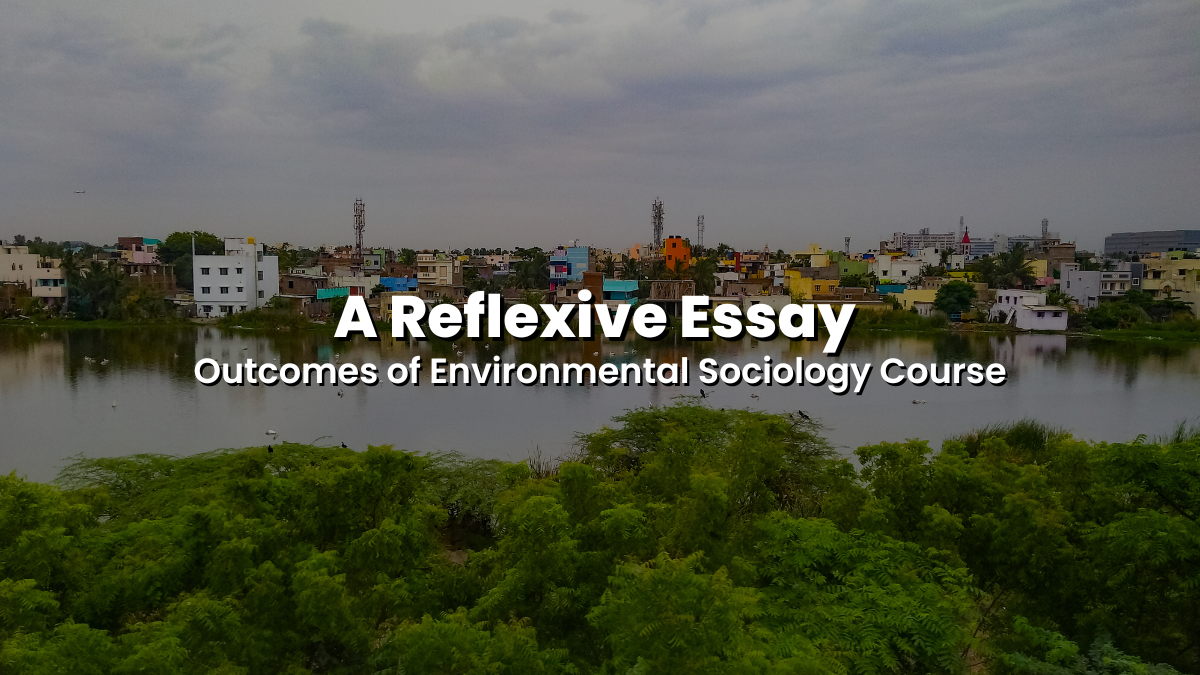
One of the meaningful concepts I encountered in environmental sociology is the beauty of ecology which emphasizes that nature should be valued not only for its economic benefits but also for its intrinsic beauty and ecological balance. This concept encourages individuals to cultivate an emotional and ethical relationship with nature. Before studying this idea, I rarely paused to reflect on the aesthetic and ecological value of the natural spaces around me. Integrating the concept of beauty of ecology with Robert Redfield’s little community that referred to how the relationship between people and environment is sacred and harmonious (Robert Redfield, 1955) also made me conscious on how first world countries are focused only on beautification of natural environment and third world countries blindly follow this model which remains inherently problematic. For instance, the disappearance of lakes, wetlands, and green spaces due to urban expansion has become more noticeable to me.
When I see areas where natural spaces have been replaced by buildings or infrastructure, I feel a stronger awareness of what is being lost. The concept has made me realize that nature is not just for beautification but it deserves appreciation and protection. This reflection has encouraged me to value and respect natural spaces in everyday life rather than looking onto how to modify it for human benefits.
Environmental Justice Paradigm
Another concept that significantly influenced my thinking is the environmental justice paradigm, which looks into how environment and its species diversity deserves justice and equality. It includes flora, fauna and human species. Because of our conspicuous consumption, these species are degraded. This nature of behavior discounts the rights of all species.This perspective expands my view that justice should extend beyond humans i.e. from being anthropocentric to becoming ecocentric. The concept also focuses on how marginalized communities often bear a disproportionate burden of environmental risks such as pollution, waste disposal and vulnerability to natural disasters.
This perspective helped me understand that environmental problems are also social justice issues. In cities like Chennai, certain neighborhoods are more vulnerable to flooding, water scarcity and poor waste management than others. These inequalities are often connected to economic conditions, infrastructure development and urban planning decisions.
Reflecting on all these has made me more attentive to the ways environmental issues affect different communities in unequal ways. For example, during discussions about urban flooding or waste management problems, I began to realize that the impacts are not experienced equally by all residents. This helped me understand that environmental protection must also involve fairness, equity and inclusive policies. It has motivated me to think about environmental sustainability not only as an ecological concern but also as an ethical and social responsibility.
Eco-Feminism
The concept of Ecofeminism provided another important perspective by highlighting the fundamental connection between the exploitation of nature and the oppression of women. Ecofeminism argues that patriarchal norms that dominate natural resources often marginalize women, particularly in societies where women are closely involved in managing household resources.
Learning about Ecofeminism helped me recognize how women often play a significant role in environmental sustainability through everyday practices. In many households, women are responsible for managing water, food and household consumption which gives them a unique relationship with natural resources.
After studying the concepts of Vandana Shiva on Ecofeminism, I observed it in my own family about how my mother plays an important role in routines of food management, household consumption, carefully using water, or reusing materials denoting its importance. Earlier, these activities seemed like routine domestic responsibilities. However, through the lens of ecofeminism, I now see them as important forms of environmental care and resource management. This reflection has helped me appreciate the environmental knowledge embedded in everyday practices. It also made me realize that sustainability is not always the result of large environmental movements; it can also be rooted in small, consistent actions carried out within daily life. I also felt the need of modern emerging society to move from phallocentrism to gynocentrism to resist capitalist environmental degradation that disproportionately affects women.
Juliet Schor’s Work and Spend Theory, Retailtainment and Consumer Culture
The work of Juliet Schor introduced me to the idea of the “work and spend” cycle, which explains how modern consumer societies encourage individuals to work longer hours in order to earn more income and subsequently spend more on goods and services. This pattern leads to continuous cycles of consumption and production, which place increasing pressure on environmental resources.
This concept made me reflect on the influence of consumer culture in everyday life, especially among young people. This consumerist culture results in environmental hazards where we consume more than we need.
Retailtainment is another concept where shopping is considered as an immersive experience which gives satisfaction and happiness. This becomes problematic when individuals engage in conspicuous consumption which is unimaginably harmful to environment as it benefits only the capitalist structures.
After learning about these concepts, I began to question some of my own consumption habits. I realized that many purchases are influenced not by necessity but by social expectations or temporary desires. This awareness has encouraged me to be more mindful when making purchasing decisions.
Environmentalism
One of the key insight from Environmental Sociology is the concept of environmentalism, which highlights the importance of both structure and agency in addressing environmental problems.
Individual agency refers to the actions people take in their daily lives to reduce environmental harm through self-awareness. In my routine, I try to adopt small practices such as reducing plastic usage, switching off unnecessary electrical appliances, and being mindful about water usage. These actions may seem minor, but they reflect a sense of environmental responsibility.
However, Environmental Sociology also taught me that individual efforts alone cannot solve large-scale environmental problems. The roles of structures which includes government policies, urban planning, and institutional regulations, plays a crucial role in shaping environmental outcomes. For example, effective waste management systems, environmental regulations, and sustainable urban planning are necessary to address issues such as pollution and flooding in cities like Chennai. Understanding this balance between personal responsibility and institutional change has helped me develop a more realistic and comprehensive view of environmental sustainability.
Conclusion
In conclusion, the study of Environmental Sociology has significantly shaped my understanding of the relationship between society and the environment. Concepts such as the beauty of ecology, environmental justice, ecofeminism, consumer culture through the work and spend cycle, retailtainment, and environmentalism have provided valuable insights into how environmental problems are connected to social practices and structures.
Reflecting on these concepts has made me observe my everyday surroundings more critically and to reconsider my own behavior in relation to the environment. In conclusion Environmental Sociology has therefore not only expanded my academic knowledge but has also influenced the way I understand my role in contributing to a more sustainable and socially just society.
References
- Dunlap, R. E., & Catton, W. R. (1979). Environmental sociology: A new paradigm.
- Redfield, R. (1955). The Little Community and Peasant Society and Culture. Chicago: University of Chicago Press
- Shiva, V. (1988). Staying Alive: Women, Ecology and Development.
- Schor, J. B. (1998). The Overspent American: Why We Want What We Don’t Need. New York: HarperCollins.