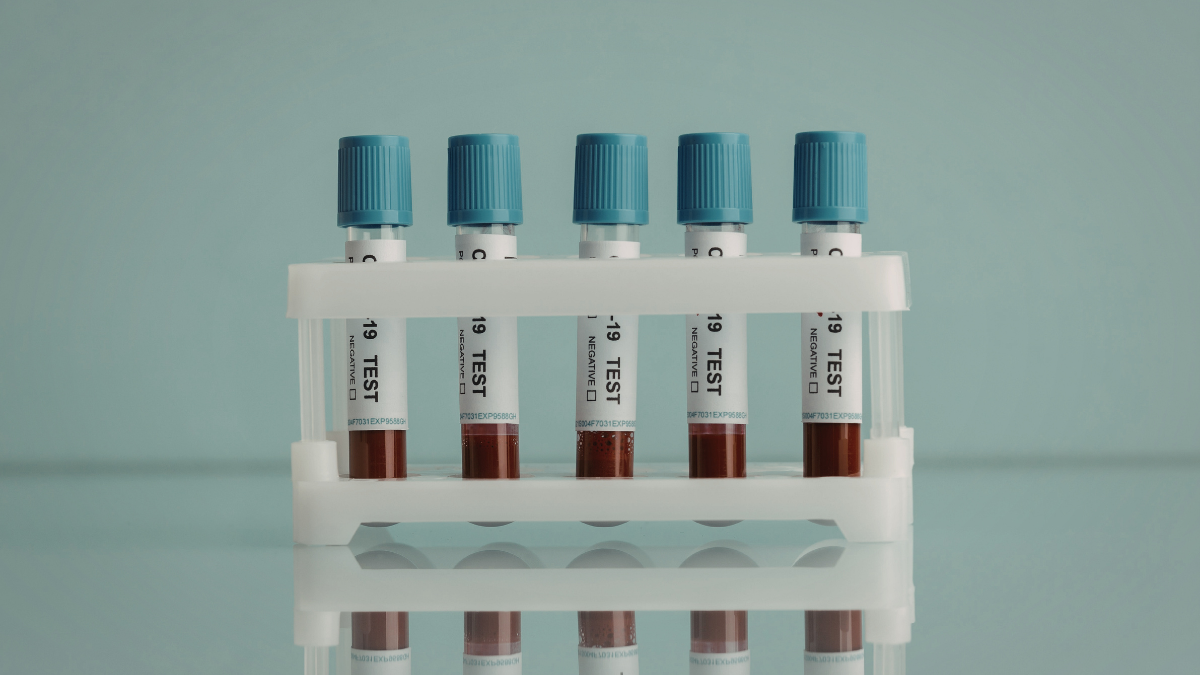
Recently, Superpower reached out and offered me the opportunity to try their Superpower Basic Health Panel in exchange for writing about the experience. As a sociologist, I approached the process with a mix of curiosity and observation. What happens when a digital platform analyzes your body through dozens of biomarkers? How does interacting with an AI health assistant shape the way we understand ourselves?
What followed felt less like a traditional medical appointment and more like a small ethnographic encounter with a system designed to interpret the body through data.
Trying the Superpower Basic Health Panel
The process of setting up my Superpower Basic Health Panel was straightforward. The platform helped me locate a nearby lab and generated the paperwork I needed for my blood draw appointment. Once I arrived, everything went smoothly. The testing itself felt very similar to any standard lab visit.
In many ways, the physical interaction with the healthcare system lasted only a few minutes.
But the real experience of the Superpower Basic Health Panel began after the blood sample was taken.
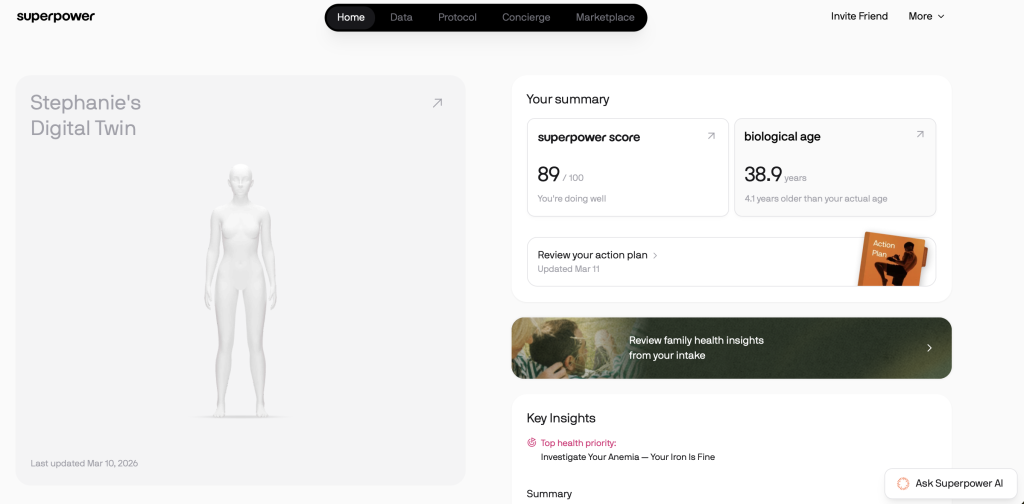
Within a few days, my lab results appeared in the Superpower platform. Like many digital health systems, the interface presented my body as a series of numbers, ranges, and visualizations based on biomarker testing. The platform also calculated my biological age, placing me at 38.9 years old. I am currently 34 and about to turn 35.
Seeing the body translated into metrics like this is a familiar feature of contemporary health culture. Wearables track our steps, apps measure our sleep, and increasingly, platforms translate blood chemistry into indicators of aging and health risk.
The body becomes something we can monitor continuously.
Michel Foucault famously described modern societies as systems that regulate populations through what he called biopower—forms of knowledge and governance that focus on managing bodies, health, and life itself. In many ways, digital biomarker platforms like the Superpower Basic Health Panel are a modern extension of that logic. The body is observed, measured, and interpreted through biomedical indicators.
But what makes systems like Superpower different is who gets access to that knowledge.
The (Bio)Power of Asking Questions
In traditional healthcare settings, access to interpretation is limited. A patient might receive lab results during a short appointment, often compressed into a fifteen-minute visit. There is rarely time to explore every question that arises from those numbers.
The Superpower Basic Health Panel introduces a different dynamic. Once my results were available, I could ask the AI assistant questions at any time.
And I did.
One marker the system flagged was my Systemic Inflammation Index (SII). My score was 824—technically within the normal range but approaching the upper limit of 900. Seeing that number naturally raised concerns. Was something in my body indicating inflammation?
This is where the Superpower AI analysis became particularly interesting.
A few years ago, a doctor initially interpreted my bloodwork as showing severe anemia. But I knew that thalassemia trait runs in my family, which can produce lab results that resemble anemia without actually reflecting iron deficiency. After additional testing, that suspicion was confirmed.
When I asked the Superpower system about my inflammation index, it analyzed my lab results in aggregate and reached a similar conclusion. It explained that my SII was elevated largely because of my platelet count, which is influenced by the thalassemia trait. Because thalassemia produces smaller red blood cells, the body compensates by producing more of them, which can also influence platelet counts.
The system almost immediately recognized that my biomarkers did not necessarily indicate inflammation. Instead, they reflected a genetic blood trait that affects how those markers appear. What stood out to me was that this interpretation emerged through an extended dialogue. I was able to ask follow-up questions and explore how different biomarkers interact with each other. In other words, I was participating in the interpretation of my own body.
From Surveillance to Self-Knowledge
Foucault often described systems of surveillance as mechanisms of control. Institutions observe bodies, categorize them, and regulate behavior. But, digital health technologies introduce an interesting twist to that framework. The surveillance of the body is no longer limited to medical institutions. Increasingly, individuals themselves are participating in the monitoring process through tools like the Superpower Basic Health Panel.
Instead of a doctor briefly explaining a lab result, I could sit with the system and ask dozens of questions about what those numbers meant. I could explore the reasoning behind the recommendations. I could test different scenarios and ask what might influence certain biomarkers.
In this sense, the same systems that monitor the body can also democratize access to health knowledge. One moment that illustrated this democratization process particularly well came when I mentioned that I had started taking a prenatal vitamin. My partner and I are planning to try to conceive later this year, so I was curious how that context might affect the system’s recommendations.
The Superpower AI concierge incorporated that information into its analysis. It suggested that my partner consider testing for the thalassemia trait, since both partners carrying the trait can have implications for future children. It also recommended discussing my current fluoxetine prescription with my healthcare provider and advised discontinuing any ashwagandha supplements before attempting conception due to limited safety data during pregnancy.
The system was not replacing medical advice, but it was expanding the space in which those conversations could happen.
A Balanced Approach to Supplements
Another interesting dimension of the Superpower Basic Health Panel involves its supplement recommendations. In the world of digital health, these recommendations can sometimes feel aggressively commercial. But, what I noticed with Superpower was a relatively restrained approach.
Some of my markers, like cortisol and DHEA-S, were slightly lower than optimal but still within normal ranges. When I asked about them, the system suggested a few supplements that could help optimize those levels. But they were not automatically included in my main protocol because they were not considered major concerns.
Also important, the platform makes it clear that you are in control of your protocol. Every supplement recommendation includes a visible “skip” option, and building your protocol simply involves checking the boxes for the suggestions you want to include.
Nothing about the process felt pushy or sales-driven.
Where the Superpower Algorithm Struggles
The only real limitation I encountered involved the biological age calculation.
Because the algorithm reads lab markers at face value, my thalassemia-related blood markers artificially inflated my biological age estimate. When I asked about this, the system acknowledged the issue and explained that the algorithm cannot currently re-run the calculation while excluding genetically fixed markers.
In other words, the platform could recognize the context but could not fully adjust the metric.
After directly asking my Superpower AI concierge, they recommended formally adding my thalassemia trait diagnosis to my records so that my care plan reflects it accurately. Based on my other biomarkers, the system indicated that my actual biological age is likely much closer to my chronological age.
This highlights a broader challenge with algorithmic health metrics: standardized models of the body do not always account for individual genetic variation. An interesting conclusion given the promise that AI will individualize our healthcare needs.
Watching Ourselves More Closely through the Superpower Basic Health Panel
My experience with the Superpower Basic Health Panel ultimately felt like a small glimpse into the evolving relationship between individuals, health data, and technology. We live in a moment where our bodies are increasingly legible through numbers. Blood chemistry, heart rate variability, sleep cycles, and metabolic markers are becoming part of everyday conversations about wellness.
From a sociological perspective, this reflects the continuing expansion of biopower: systems that monitor, measure, and interpret human bodies, and all for the sake of power. But unlike earlier forms of medical surveillance, digital tools like the Superpower Basic Health Panel also place interpretive tools directly into the hands of individuals. Instead of passively receiving information about our health, we can interact with it, question it, and explore what it means.
In my case, the most valuable part of the experience was not the lab test itself. It was the ability to spend time exploring my health data in a way that simply is not possible during a typical doctor’s appointment.
Sometimes the most empowering thing about understanding the body is simply having the time to ask questions.
Curious About Your Own Biomarkers?
If you are interested in exploring your own health data in a similar way, Superpower offers the same Superpower Basic Health Panel I used for this experience. One of the things I appreciated most about the platform was the ability to sit with the results and ask questions at your own pace, rather than trying to fit everything into a short doctor’s appointment. Overall, I had a great experience and was deeply fascinated by the sociological questions I encountered during my trial of Superpower.
Curious? Try Superpower Health for yourself today!
Disclosure: Superpower provided me with access to the Basic Health Panel for this review. The link above is also an affiliate link, which means I may receive a small commission if you decide to try the service. As always, my reflections here are based on my personal experience.