Applied sociology often lives at the intersection of lived experience and institutional accountability. When sociologists move into consulting, they bring more than theory. They bring analytic frameworks capable of uncovering patterns that organizations struggle—or sometimes refuse—to see. That is exactly the work Dr. Karine Coen-Sanchez has formalized through the launch of her new consultancy, Karine Consults.
Get to Know Karine Consults
Karine Consults is a consulting practice grounded in applied sociology, organizational analysis, and equity-centered risk management.
Founded by Dr. Karine Coen-Sanchez, Karine Consults works with institutions to interrogate how credibility, hierarchy, bias, and institutional consciousness are socially structured—and how those structures produce measurable organizational consequences. The practice is grounded in peer-reviewed and qualitative research, including grounded theory approaches, ensuring that institutional analysis is both theoretically rigorous and empirically informed. It also emphasizes measurable institutional outcomes, supporting organizations in identifying patterns, mitigating systemic risks, and designing accountability mechanisms that produce sustainable structural change rather than symbolic adjustment.
Clients seek Karine Consults for its ability to:
• Diagnose systemic and behavioral drivers of institutional friction
• Strengthen governance, decision-making, and accountability structures
• Design behaviour-informed mitigation and change strategies
• Navigate conflict, informal systems, and organizational dynamics
• Bridge policy, practice, and operational realities
• Support leadership reflection and executive decision environments
Karine Consults operates from a central premise: institutions do not merely contain inequities—they organize, normalize, and reproduce them through everyday structures, norms, and decision-making practices. Therefore, rather than offering surface-level diversity programming, Karine Consults focuses on structural consulting that addresses institutional systems, not individual optics.
Karine Consults and the Power of Positionality
At the core of Karine Consults is a sophisticated engagement with positionality.
For Dr. Coen-Sanchez, positionality is not an abstract classroom concept. It is lived, imposed, resisted, and ultimately embraced. She describes the burden many racialized professionals recognize when naming the responsibility of validating truth and reality to a broader collective consciousness. Karine Consults transforms that lived reality into an analytic method.
Through structural analysis, Karine Consults helps organizations examine:
- How credibility is assigned
- Who is presumed competent
- Who must over-credential themselves to be heard
- How “neutral” standards maintain normative hierarchy
This work shifts the focus from personal performance to institutional structure.
Equity as Institutional Risk Strategy
One of the defining contributions of Karine Consults is reframing equity as institutional risk management.
Many organizations treat equity as symbolic compliance or reputational positioning. Karine Consults instead demonstrates how unexamined bias creates tangible institutional risk:
- High turnover among Black and other racialized employees,
- Retention failures disguised as “fit,”
- Trust erosion across teams,
- Reputational vulnerability, and
- Legal exposure.
In this framework, equity is not moral branding. Rather, it is operational sustainability.
Karine Consults has recently worked with the federal government to analyze how patterns of hiring discrimination are demonstrated to deputies. A common institutional defense is the claim that incidents are isolated. Karine Consults applies sociological pattern recognition to demonstrate systemic trends rather than one-off events.
In doing so, she shifts the conversation from intent to impact. While intent may be defended, impact reveals structure—and using a conceptual framework she developed allows her to reveal that which may seem hidden to organizational leaders.
Naming Subtle Harm: Polite Racism and Duplicity of Consciousness
Karine Consults introduces language for harms that often remain unnamed because they are subtle or civil.
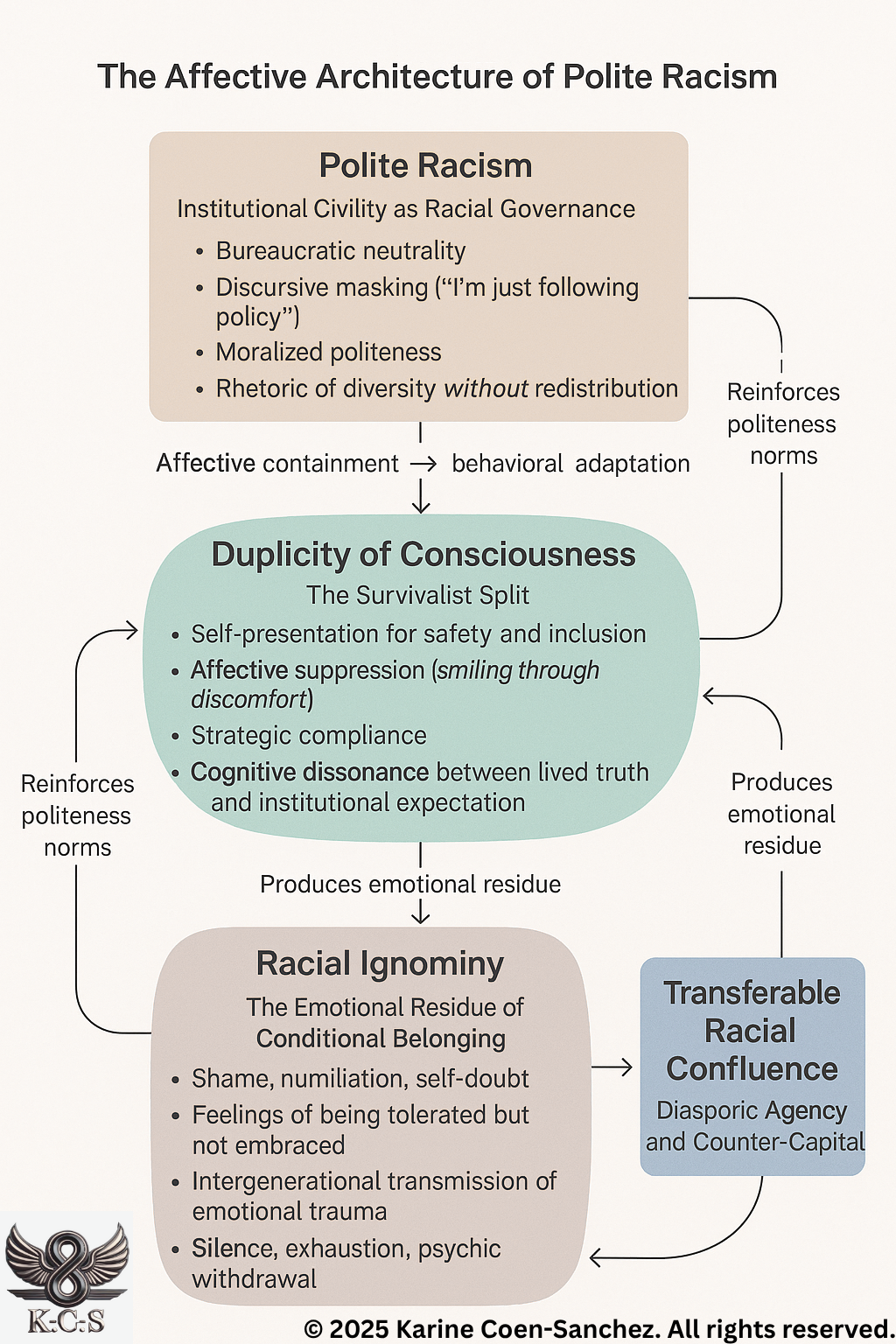
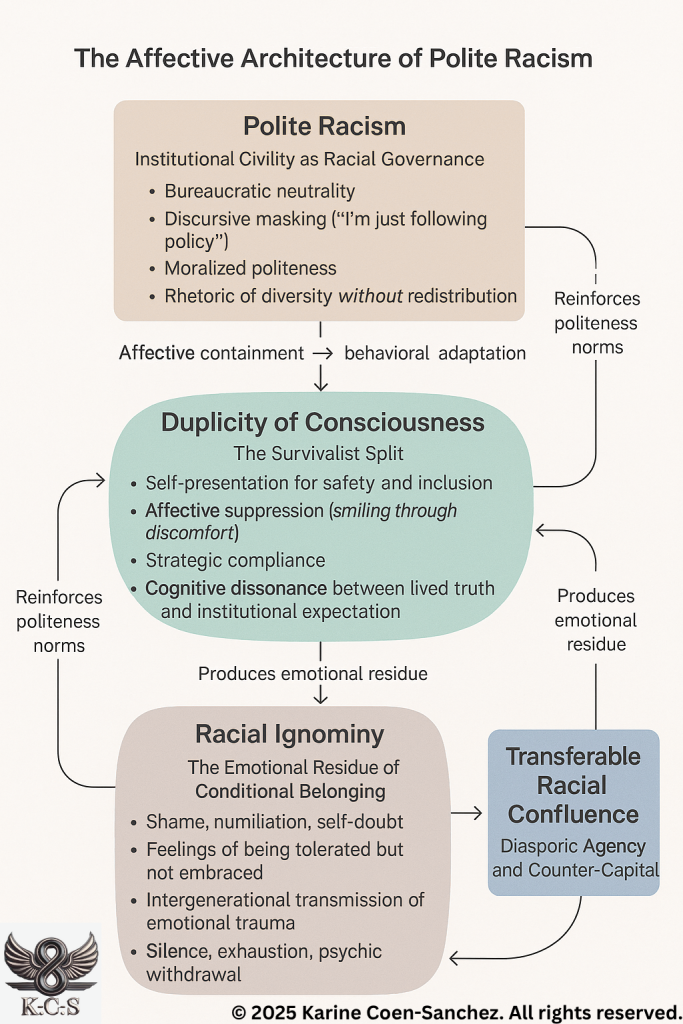
For example, Dr. Coen-Sanchez uses the term “polite racism” to describe coded professional interactions that preserve hierarchy under the guise of civility. She also explores the “duplicity of consciousness,” what she deems the dual awareness many marginalized professionals maintain as they calculate credibility, perception, and risk before speaking.
Over time, these dynamics produce what she describes as racial ignominy: the emotional, psychological, and reputational toll of repeated coded harm.
Karine Consults helps organizations confront not diversity itself, but the maintenance of normative hierarchy under the illusion of neutrality.
Why Karine Consults Matters for Applied Sociology
At Applied Worldwide, we define applied sociology as the use of sociological skills and knowledge to improve the well-being of society.
Karine Consults embodies that definition. More specifically, the launch of Karine Consults demonstrates what applied sociology looks like when it moves beyond theory and enters institutional decision-making spaces—not as commentary, but as strategy.
Dr. Coen-Sanchez’s practice integrates:
- Positionality theory as institutional analysis,
- Organizational sociology as structural diagnosis,
- Critical race frameworks as accountability tools,
- Institutional risk analysis as operational leverage, and
- Accountability design as measurable intervention
Karine Consult is not sociology adjacent to policy—it is sociology shaping policy.
Too often, applied sociology is framed as program evaluation, nonprofit work, or community engagement alone. While those spaces matter deeply, Karine Consults shows another dimension: sociologists operating inside systems of governance, human resources, compliance, and executive leadership—all places where institutional norms are defined, reproduced and vehemently defended.
Karine Consults also challenges an ongoing myth within academia that sociological training is most valuable inside the classroom. Dr. Coen-Sanchez’s work demonstrates that sociologists are uniquely equipped to:
- Detect patterned inequality where institutions see isolated incidents,
- Translate structural theory into risk mitigation strategy,
- Move conversations from intent to measurable impact, and
- Design accountability mechanisms grounded in reflexivity.
For students considering applied sociology careers, Karine Consults provides a concrete example of how doctoral training can translate into tangible institutional transformation.
For sociology departments, this example of applied sociology poses a larger question: are we preparing students to intervene in power structures, or merely to describe them?
At Applied Worldwide, we believe documenting and amplifying work like Karine Consults is part of strengthening the applied sociology ecosystem. When consulting practices grounded in rigorous sociological analysis emerge, they expand the professional imagination of what sociology can do.
In the case of Karine Consults, structural insight becomes institutional impact—and institutional impact becomes societal change.
Learn more about Karine Consults at:
www.karine-consults.com